:: ERROR 404 · NOT FOUND ::
404
404 noun — the HTTP status code for “Not Found.” The message a server returns when the page you asked for doesn't exist at that address.
The full entry — history, the CERN myth, 404 vs 410 →Where it sits
The codes either side of it.
Seven replies a server can give you. Only one of them is about a page that isn't there.
- 400Bad RequestThe ask itself was malformed. The server could not parse it.
- 401UnauthorizedNo valid credentials arrived. Despite the name, this is about proving who you are.
- 403ForbiddenIt exists, and you are refused. Signing in will not always help.
- 404Not FoundNothing at this address — and no claim about whether anything ever was.
- 410GoneRemoved deliberately, and unlikely to return.
- 451Unavailable For Legal ReasonsAccess denied as a consequence of a legal demand.
- 500Internal Server ErrorThe server broke. This one genuinely is not you.
451 is the strange one: it reports a legal obstacle rather than a technical one, and was standardised in RFC 7725 in February 2016. Its acknowledgements thank Terence Eden for noticing that 403 would not do — and then, without further comment, “Thanks also to Ray Bradbury.”
The full entry on 404 — the spec, the myth, the soft 404 →Asked often
Four questions the entry does not cover.
How do you fix a 404 error as a visitor?
Usually by correcting the address or finding the page another way — a 404 is almost never something you can repair from your side. Check the URL for a typo or a stray character, strip it back to the site's home page and navigate in, or search the site for the title you wanted. If a link brought you here, the page it pointed at has most likely moved or been deleted, and only the site's owner can fix that.
Do 404 errors hurt your SEO?
No. Google's own guidance is explicit: “404 errors are a perfectly normal part of the web,” and it adds that when you remove a page it actually prefers a proper 404 or 410 over a soft 404 that returns a success code. What does cost you is a broken internal link a visitor follows, or a deleted page that still has links pointing at it from elsewhere — that is lost traffic rather than a ranking penalty.
What makes a good 404 page?
One that returns a real 404 status code, then helps. The code matters most: a page that says “not found” while returning 200 OK is a soft 404, and it tells search engines a genuine page lives at a dead address. Beyond that, a good one says plainly what happened, offers a search box and a route back into the site, and keeps the site's own navigation — so a dead end becomes a doorway.
What is the difference between a 404 and a 500 error?
404 means the server is fine and the page is not there; 500 means the server itself broke. A 404 sits in the 4xx block, where the specification treats the request as the problem — the address you asked for has nothing behind it. A 500 is in the 5xx block, which is the server admitting the fault is its own. If you are seeing 500s, refreshing later is reasonable; with a 404 the page is genuinely not at that address.
The ranking answer quotes Google Search Central, “Do 404 errors hurt my site?”
You already know the feeling of not found.
It's the thing you feel with no name for it. The word on the tip of your tongue. The search that returns nothing useful because you didn't know what to call it in the first place.
That's what this dictionary is for. Not the words you can already look up — the un-findable ones. Describe the feeling, and we'll hand you its word.
Start here
Describe a feeling. We'll find its word.
413 words so far, across 19 genres — each one defined, sourced, and explained properly.
featured transmissions
- Tech & AI404404 is the HTTP status code a web server returns when it can be reached perfectly well but has n…
- Philosophy & Ways of LivingAbsurdismAbsurdism is the philosophical and literary position that meaning is something we demand and the…
- Rare & Beautiful EnglishAcatalepsyThe doctrine that certain knowledge is unattainable — that human understanding can reach probabi…
- Cognitive Biases & the MindActor-Observer BiasActor-observer bias is the proposed tendency to explain your own behaviour by your circumstances…
- Head WordsAestheticRelating to beauty, or pleasing in appearance — and, as a noun, either the philosophical discipl…
- Internet & Digital CultureAI SlopLow-quality, low-effort generative-AI content — competent on the surface, cheap to make, produce…
- Philosophy & Ways of LivingAkrasiaAkrasia is weakness of will: doing what you yourself judge to be the worse option, at the moment…
- Science & NatureAlbedoAlbedo is how reflective a surface is — the fraction of the light or radiation falling on it, us…
Word of the day
One word a day, from the ones nobody can find.
mah-mee-lah-pin-ah-tah-PIE
Mamihlapinatapai is a Yaghan word famous in English for a wordless look between two people who each want the other to act — a definition the linguistic evidence supports far more weakly than the internet suggests.
Read the full entry →Or wander in
Words people couldn't find
- Psychology & Relationship DynamicsLimerenceLimerence is an involuntary state of intense romantic obsession, in which your mind fixes on one person …
- Untranslatable & Rare FeelingsSaudadeSaudade is a Portuguese word for the bittersweet ache of missing someone or something absent — a longing…
- Modern Dating & ConnectionSituationshipA situationship is a romantic or sexual relationship that's been left undefined — you're involved, but w…
- Rare & Beautiful EnglishSonderSonder is the sudden realization that every passing stranger is living a life as vivid and complex as yo…
- Psychology & Relationship DynamicsDoomscrollingDoomscrolling is the compulsive habit of scrolling through a bottomless feed of bad news, unable to stop…
- Philosophy & Ways of LivingIkigaiIkigai is a Japanese word for your reason for living — the sense of purpose or worth that makes life fee…
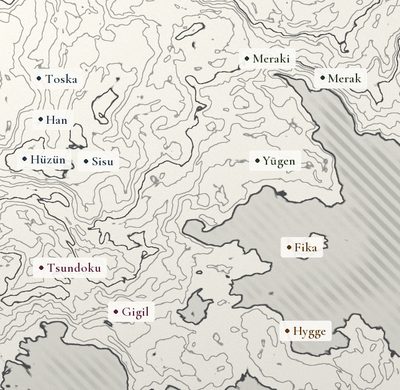
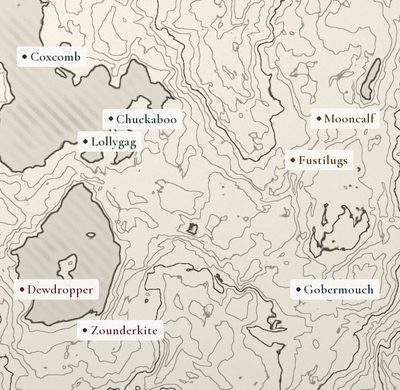
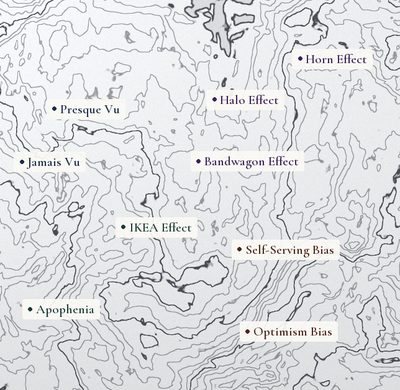
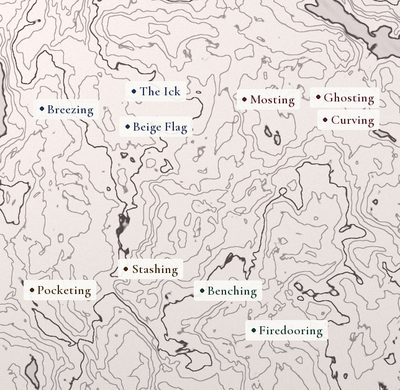
Drawn maps
Some words make more sense on a map.
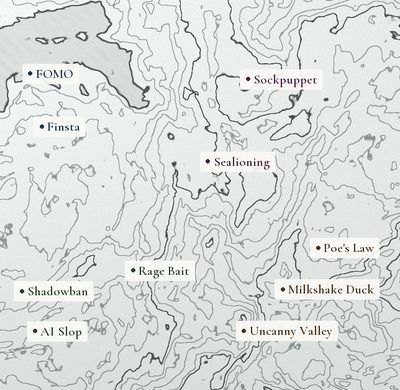
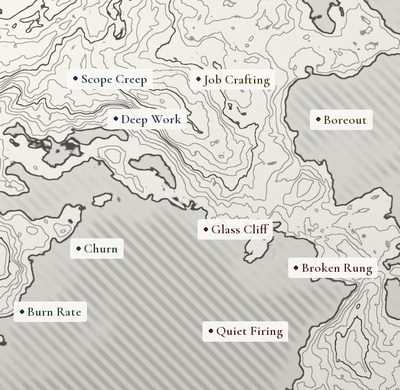
Each map places a family of words by what they have in common, so you can see the ground between them. Every name opens its entry.
- Map · 51 wordsUntranslatable words51 feelings English has no word for.
- Map · 20 wordsOld-fashioned insults20 old insults, and which of them are real.
- Map · 38 wordsCognitive biases38 ways a mind gets it wrong.
- Map · 38 wordsDating terms38 words for what dating does now.
- Map · 34 wordsInternet terms34 words the internet needed.
- Map · 36 wordsWorkplace terms36 words for what work does to people.
- Reverse dictionaryWhat's the word for…?Describe the feeling. It finds the word.
Everything in here
Pick a door.
And when a word is too alive to sit still
Some words are places.
Six of them are built as worlds you can walk into — each with its own design, its own motion, and hundreds of pages inside.
Enter the corridor →